
ASX: HAS $
ASX: HAS $
Our products
Rare earths are a group of 15 elements in the periodic table known as the lanthanide series. The use of the term ‘rare earths’ is somewhat misleading as the elements are not particularly rare in nature, however due to their geochemical properties, rare earths are ty dispersed and not often found in concentrated clusters to make them viable to mine.
Rare Earths make the technology we use in everyday life possible from medical applications to digital devices and increasingly in the development of humanoid robotics. Their magnetic, phosphorescent, and catalytic properties make them essential for the continued evolution of technologies used in modern society.
Each rare earth deposit has its own unique suite of minerals and due to their high demand in the manufacturing of magnets, the most valuable rare earths include neodymium (Nd), praseodymium (Pr), dysprosium, terbium and samarium.
Each rare earth deposit has its own unique suite of minerals and due to their high demand in the manufacturing of magnets, the most valuable rare earths include neodymium (Nd), praseodymium (Pr), dysprosium, terbium and samarium.
Role of rare earths in the energy transition
An energy system powered by clean energy technologies differs profoundly from one fuelled by traditional hydrocarbon resources. Solar photovoltaic plants, wind farms and electric vehicles generally require more minerals to build than their fossil fuel-based counterparts.
A typical electric car requires six times the mineral inputs of a conventional car and an onshore wind plant requires nine times more mineral resources than a gas-fired power plant.
A typical electric car requires six times the mineral inputs of a conventional car and an onshore wind plant requires nine times more mineral resources than a gas-fired power plant.

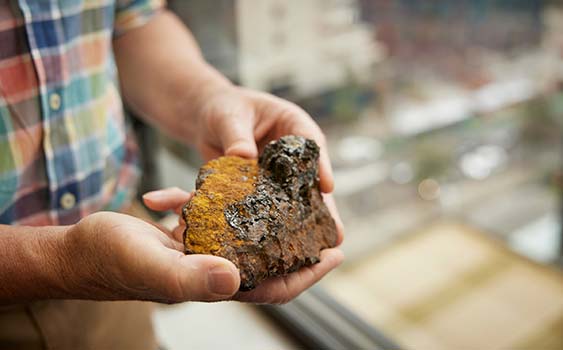
Since 2010, the average amount of minerals needed for a new unit of power generation capacity has increased by 50% as the share of renewables in new investment has increased.
NdPr are used in over 90% of manufacturing of NdFeB or permanent magnets. These are the strongest magnets available and are key to the efficient conversion of electrical energy into motion.
These permanent magnets are the enabling technology for the widespread electrification of transport, as well as wind turbines for renewable energy.
NdPr are used in over 90% of manufacturing of NdFeB or permanent magnets. These are the strongest magnets available and are key to the efficient conversion of electrical energy into motion.
These permanent magnets are the enabling technology for the widespread electrification of transport, as well as wind turbines for renewable energy.
Electrifying the automotive sector
By 2032, anticipated global rare earth magnet demand is forecast to outstrip supply by the equivalent of 13 times the projected NdPr output of Yangibana.
As the dominant EV motor technology, sintered NdFeB magnets (rare earth magnets) have more than 90% market share among leading automotive original equipment manufacturers.
As the dominant EV motor technology, sintered NdFeB magnets (rare earth magnets) have more than 90% market share among leading automotive original equipment manufacturers.
3,400tpa
NdPr production equivalent from Yangibana Project
55 million
Number of electric vehicles Yangibana will supply over 17-year mine life
1.2bn tonnes
Reduction in carbon emissions (compared to internal combustion engine)
Capitalising on a global supply deficit
Fuelled by the global transition to clean energy, demand for permanent magnets used in electric vehicles and wind turbines is forecast to growth at a compound annual growth rate of 7.8% in the next decade.
Electric drivetrains and wind energy is expected to represent 59% of rare earth oxide demand for magnets by 2032, with electric vehicle demand to growth significant as governments ban the sale of the traditional internal combustion engine. In addition, wind power has been identified as the fastest growing renewable energy technology by the International Renewable Energy Agency with installed capacity to grow around two times through to 2030.
Other demand sources for these magnets include the growing areas of humanoid robotics, consumer electronics, industrial applications and air-conditioning.
As a result, it is expected that the demand for rare earth elements – in particular NdPr – will exceed current production rates by 2025, resulting in a sizeable supply gap growing to 2032, representing around 13 times the projected NdPr oxide output of Yangibana. New and more diversified supply sources will be vital, with long project development lead times raising questions around the ability of supply ramp up.
With first concentrate from Yangibana expected in Q2 2025, the project is well-timed to start meeting this increase in demand.
Electric drivetrains and wind energy is expected to represent 59% of rare earth oxide demand for magnets by 2032, with electric vehicle demand to growth significant as governments ban the sale of the traditional internal combustion engine. In addition, wind power has been identified as the fastest growing renewable energy technology by the International Renewable Energy Agency with installed capacity to grow around two times through to 2030.
Other demand sources for these magnets include the growing areas of humanoid robotics, consumer electronics, industrial applications and air-conditioning.
As a result, it is expected that the demand for rare earth elements – in particular NdPr – will exceed current production rates by 2025, resulting in a sizeable supply gap growing to 2032, representing around 13 times the projected NdPr oxide output of Yangibana. New and more diversified supply sources will be vital, with long project development lead times raising questions around the ability of supply ramp up.
With first concentrate from Yangibana expected in Q2 2025, the project is well-timed to start meeting this increase in demand.
Yangibana Project
The Yangibana Project occupies 650 square kilometres and is located approximately 250 kilometres northeast of Carnarvon in Western Australia. The projected is located on Gifford Creek Station, which covers Thiin-Mah, Warriyangka, Tharrkari and Jiwarli country.
Since the discovery of Yangibana in 2014, the Project has progressed steadily from exploration into construction (early works) and we envisage production to commence by Q2 2025.
Since the discovery of Yangibana in 2014, the Project has progressed steadily from exploration into construction (early works) and we envisage production to commence by Q2 2025.
Yangibana,
our superior
world-class project
17 years
Initial
mine life
mine life
37%
Average
NdPr:TREO ratio
NdPr:TREO ratio
Q2 2025
First
production
production
37,000tpa
Stage 1 – concentrate production
3,400tpa
NdPr production equivalent
Unique tier one asset
Yangibana is a world-class rare earths deposit located in a tier one jurisdiction, containing an unrivalled percentage of NdPr to Total Rare Earth Oxide in the orebody, averaging 37% over the life of mine and up to 52% in some areas of the deposit.
Since the first drill program at Yangibana in 2014, Hastings has continuously grown its resources and reserves through ongoing exploration and metallurgy test work.
The Yangibana Project has a current Mineral Resource of 29.93mt at 0.93% TREO (0.32% Nd2O3+Pr6O11). An Ore Reserve of 20.93mt at 0.90% TREO (0.33% Nd2O3+Pr6O11) supports an expected mine operating life of at least 17 years.
Since the first drill program at Yangibana in 2014, Hastings has continuously grown its resources and reserves through ongoing exploration and metallurgy test work.
The Yangibana Project has a current Mineral Resource of 29.93mt at 0.93% TREO (0.32% Nd2O3+Pr6O11). An Ore Reserve of 20.93mt at 0.90% TREO (0.33% Nd2O3+Pr6O11) supports an expected mine operating life of at least 17 years.
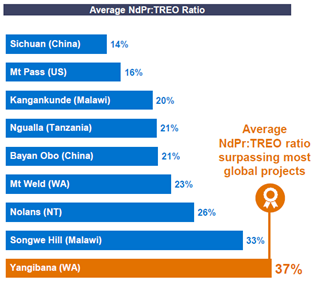
Exploration will remain a focus for Hastings as we look to continuously growth our Resources and Reserves, with aero-magnetic and radiometric surveys from 2018 unveiling extensive areas for future drilling.
Operations
The Yangibana Project will be developed in two stages, with Stage 1 focused on the mine and beneficiation plant to produce a rare earth concentrate.
The mining operations at Yangibana will comprise open pit mining, including conventional drill, blast, load and haul, with an estimated ore feed of 1.1 million tonnes per annum into the processing plant. The mined ore will be processed through a circuit of crushing, grinding, floatation, tailings and handling, with an output of up to 37,000 tonnes per annum of rare earth concentrate at 27% TREO.
In Stage 2, a hydrometallurgical plant will be constructed which will process the concentrate from Yangibana into an intermediate product called a mixed rare earth carbonate (MREC), through a process of cracking, leaching, precipitation and drying.
Once completed, the plant will have an output of up to 15,000 tonnes per annum of MREC at 59% TREO, to be shipped to our customers for further downstream processing into NdPr oxides, which are then metallised and alloyed before being made into a permanent magnet.
The Yangibana Project is fully permitted for first rare earth concentrate production in the first half of 2025.
The mining operations at Yangibana will comprise open pit mining, including conventional drill, blast, load and haul, with an estimated ore feed of 1.1 million tonnes per annum into the processing plant. The mined ore will be processed through a circuit of crushing, grinding, floatation, tailings and handling, with an output of up to 37,000 tonnes per annum of rare earth concentrate at 27% TREO.
In Stage 2, a hydrometallurgical plant will be constructed which will process the concentrate from Yangibana into an intermediate product called a mixed rare earth carbonate (MREC), through a process of cracking, leaching, precipitation and drying.
Once completed, the plant will have an output of up to 15,000 tonnes per annum of MREC at 59% TREO, to be shipped to our customers for further downstream processing into NdPr oxides, which are then metallised and alloyed before being made into a permanent magnet.
The Yangibana Project is fully permitted for first rare earth concentrate production in the first half of 2025.
Mine to magnet
The increasing focus on securing sustainable and strategically aligned supply chains from Western governments is bringing critical minerals, including rare earth elements, to the forefront.
Hastings has a long-term vision to pursue a strategy of building a vertically integrated mine to magnet company, and to become a major player in building a European-centric magnet supply chain during this decade.
Hastings has a long-term vision to pursue a strategy of building a vertically integrated mine to magnet company, and to become a major player in building a European-centric magnet supply chain during this decade.
To that end, Hastings has a strategic 20% shareholding in TSX-listed Neo Performance Materials, a market leading producer of NdFeB magnets and rare earth materials globally. Neo is uniquely positioned as the owner of the only operating commercial rare earth separation and rare metals facility in Europe and have recently broken ground on its new factory in Estonia to manufacture sintered NdFeB permanent magnets.
The acquisition is funded by an investment by Wyloo Metals Ltd via the subscription of A$150 million secured, redeemable, exchangeable notes issued by Hastings. Wyloo is a subsidiary of Tattarang, one of Australia’s largest privately owned investment companies with an investment portfolio spanning across agri-food, energy, resources, property, and lifestyle.
The acquisition is funded by an investment by Wyloo Metals Ltd via the subscription of A$150 million secured, redeemable, exchangeable notes issued by Hastings. Wyloo is a subsidiary of Tattarang, one of Australia’s largest privately owned investment companies with an investment portfolio spanning across agri-food, energy, resources, property, and lifestyle.